I remember a job site several years ago where a new apprentice, eager to prove himself, grabbed an older drill with a worn-out battery for a critical task. Halfway through, the tool sputtered, died, and brought the whole assembly line to a grinding halt. That day hammered home a crucial truth: the heart of any cordless tool isn’t its motor, but its battery. Understanding the nuances of a cordless tool efficiency comparison based on battery technology isn’t just about specs; it’s about reliable performance, productivity, and ultimately, your bottom line. As technology continues its relentless march, staying abreast of battery advancements is paramount for anyone relying on portable power.
The Evolution of Cordless Power
For decades, Nickel-Cadmium (NiCad) batteries were the workhorses of the cordless tool world. They were robust, could deliver high current, and tolerated significant abuse. However, NiCads were plagued by the infamous “memory effect,” where incomplete discharge cycles could lead to a permanent reduction in capacity. They also suffered from relatively high self-discharge rates, meaning a fully charged battery could lose a significant portion of its power just sitting on the shelf.
- How to fix a washing machine drum that won't spin: Diagnosis and parts replacement
- Appliance Fault Diagnosis Models: Troubleshooting Techniques for Smarter Repairs
- Washing Machine Troubleshooting Tips for Common Issues
- Master Residential Appliance Maintenance: Smart Planning Strategies
- Budget vs. premium power tools: A real-world durability and performance deep dive
The subsequent shift to Nickel-Metal Hydride (NiMH) offered a modest improvement, boasting higher energy density and a reduced memory effect. While a step in the right direction, NiMH batteries still couldn’t completely shake off self-discharge issues and often struggled with consistent power delivery under heavy loads. It was clear that a truly revolutionary leap in battery chemistry was needed to unlock the full potential of cordless tools.
Lithium-Ion: The Reigning Champion
The advent of Lithium-ion (Li-ion) technology truly revolutionized the cordless tool industry. These batteries boast superior energy density, meaning more power packed into a lighter, more compact form factor. Crucially, Li-ion batteries suffer from virtually no memory effect, allowing users to charge them whenever convenient without fear of reducing their overall capacity. Their low self-discharge rate means tools are ready to go even after extended periods of inactivity, a massive boon for professionals.
Within the Li-ion family, various chemistries exist, each with specific advantages. While most power tools utilize chemistries like NMC (Nickel Manganese Cobalt) or NCA (Nickel Cobalt Aluminum) for their high energy density and power output, others might incorporate LiFePO4 (Lithium Iron Phosphate) for enhanced safety and longer cycle life, albeit at a slightly lower energy density. These nuanced choices by manufacturers directly impact a tool’s performance, longevity, and even its safety profile, making the battery far more than just a power source.
Understanding Voltage, Amperage, and Watt-Hours
When comparing cordless tool batteries, voltage (V) and ampere-hours (Ah) are the two most commonly cited metrics. Voltage dictates the raw power a tool can deliver; higher voltage generally means more torque and speed. Ampere-hours, on the other hand, represent the battery’s “fuel tank” – a higher Ah rating means longer run-time. It’s a common misconception that more Ah automatically equals more power; it simply means more duration at a given power output.
However, the true measure of a battery’s total energy capacity is its Watt-hours (Wh), which is calculated by multiplying voltage by ampere-hours (V x Ah = Wh). A 12V 6.0Ah battery has 72Wh, while an 18V 4.0Ah battery also has 72Wh. Understanding Watt-hours provides a more accurate cordless tool efficiency comparison based on battery technology, allowing you to gauge how much work a battery can actually do. For a deep dive into battery metrics, you might find resources from the U.S. Department of Energy insightful.
The Impact of Battery Management Systems (BMS)
Modern cordless tool batteries are far more than just a collection of cells; they incorporate sophisticated Battery Management Systems (BMS). A BMS is the brain of the battery, monitoring individual cell voltages, temperatures, and current flow. It protects against overcharge, over-discharge, and overheating, all of which can severely damage the cells or even pose safety risks. Beyond protection, a good BMS also optimizes charging and discharging cycles, balancing the cells to maximize the battery’s lifespan and ensuring consistent power delivery throughout its usage. Without a robust BMS, even the most advanced battery chemistry would struggle to perform reliably or safely.
Beyond Li-Ion: Emerging Technologies and Future Prospects
While Lithium-ion batteries currently dominate the market, research and development are constantly pushing the boundaries of battery technology. We’re on the cusp of seeing next-generation solutions, with solid-state batteries being a particularly exciting prospect. These batteries replace the liquid electrolyte in traditional Li-ion cells with a solid material, promising significantly higher energy density, faster charging times, enhanced safety (no flammable liquid electrolyte), and potentially even longer cycle life.
Looking ahead to 2026 and beyond, we can anticipate these emerging technologies to further redefine cordless tool efficiency. Imagine tools that are lighter, run for hours longer on a single charge, and can be fully recharged in minutes. Other advancements, such as silicon-anode batteries or even advanced flow batteries for specialized applications, are also on the horizon, each promising to contribute to a future where cordless power becomes even more ubiquitous and powerful, challenging the very notion of what a portable tool can achieve.
Real-World Efficiency: Matching Battery to Task
The ultimate cordless tool efficiency comparison based on battery technology comes down to real-world application. For light-duty tasks like driving screws or drilling small holes, a compact 1.5Ah or 2.0Ah battery on a 12V or 18V platform is often sufficient, keeping the tool light and maneuverable. However, for demanding applications such as cutting thick lumber with a circular saw, grinding metal, or breaking concrete with a rotary hammer, you absolutely need higher capacity batteries – typically 5.0Ah or greater, often on 18V, 20V, or even 36V/40V platforms – to deliver the sustained power and run-time required.
Maximizing job site efficiency also involves smart battery management. Investing in a rapid charger significantly reduces downtime. Furthermore, having multiple batteries and rotating them ensures that one is always ready while another is charging or cooling. This strategic approach, combined with understanding the power draw of your specific tools, prevents frustrating interruptions and keeps productivity high. For more practical tips on battery care, consider guides from reputable tool manufacturers like Milwaukee Tool.
Key Takeaways
- Lithium-ion is King: Li-ion batteries offer superior energy density, minimal self-discharge, and no memory effect, making them the gold standard for modern cordless tools due to their efficiency and convenience.
- Watt-Hours are Key: Beyond voltage and amp-hours, understanding a battery’s Watt-hour rating (V x Ah = Wh) provides the most accurate measure of its total energy capacity and potential run-time for a comprehensive cordless tool efficiency comparison.
- BMS is Essential: A sophisticated Battery Management System (BMS) is crucial for protecting battery cells, optimizing performance, extending lifespan, and ensuring safety against common issues like overcharge and overheating.
- Match Battery to Task: Selecting the correct battery capacity and voltage for the specific application is vital for maximizing efficiency; small batteries for light tasks, and high-capacity, high-voltage packs for demanding, power-hungry tools.
Frequently Asked Questions
Is it bad to leave a cordless tool battery on the charger constantly?
Modern Lithium-ion batteries with intelligent chargers and Battery Management Systems are designed to prevent overcharging. Once fully charged, the charger typically enters a maintenance mode or stops charging. While it’s generally safe, for long-term storage, it’s often recommended to store Li-ion batteries at around 50-70% charge in a cool, dry place to maximize their lifespan, rather than leaving them on a charger indefinitely.
What’s the difference between 18V and 20V Max batteries?
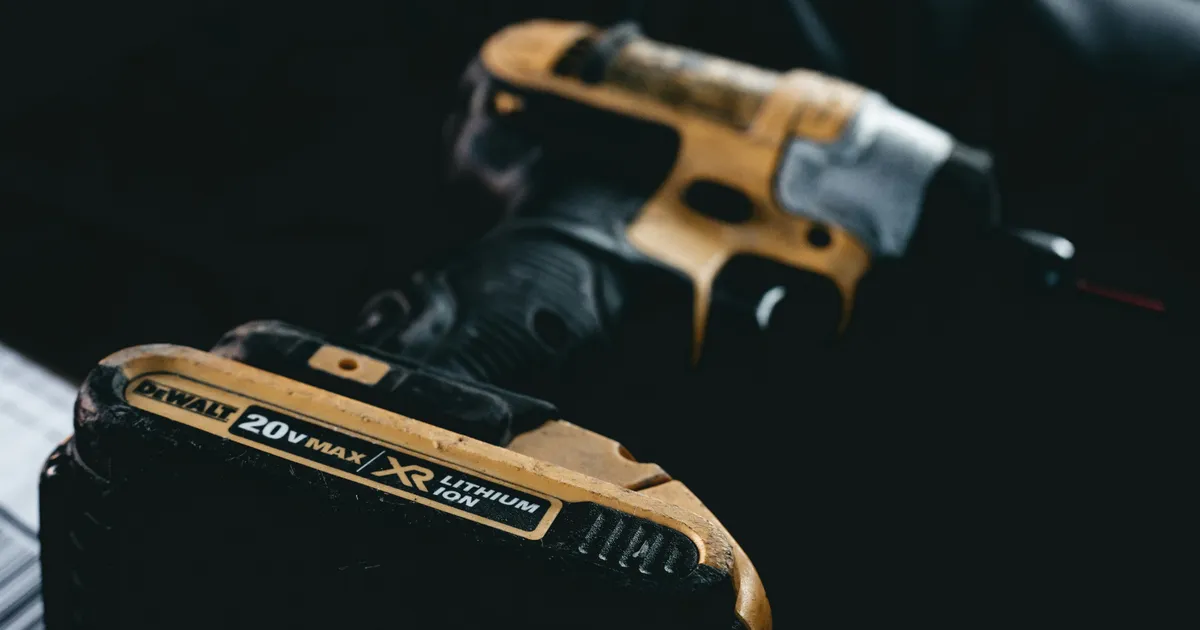
In most cases, 18V and “20V Max” batteries refer to the same nominal voltage. “20V Max” is a marketing term used by some manufacturers (like DeWalt) to indicate the battery’s maximum initial voltage when fully charged, which is around 20 volts. The battery’s nominal or sustained voltage under load is 18 volts. They are generally interchangeable within their respective brand’s 18V/20V Max ecosystems.
How can I extend the life of my cordless tool batteries?
To extend battery life, avoid fully discharging them regularly, don’t expose them to extreme temperatures (hot or cold), and use the charger designed for your specific battery. Store them partially charged (around 50-70%) in a cool, dry place when not in use for extended periods. Regular use is often better than long periods of inactivity.
Are newer battery technologies like solid-state batteries coming to power tools soon?
While solid-state batteries show immense promise, their widespread integration into consumer power tools is likely still a few years away. The technology is rapidly advancing, and we might see early commercial applications by 2026, but cost, scalability, and perfecting performance under the harsh conditions of power tool use are still hurdles to overcome before they become mainstream replacements for current Li-ion batteries.
Conclusion
The landscape of cordless tool efficiency comparison based on battery technology is dynamic, driven by relentless innovation. From the humble NiCad to the dominant Lithium-ion and the promising solid-state cells of the future, understanding these power sources is paramount. Choosing the right battery isn’t just about voltage; it’s about Watt-hours, intelligent BMS, and matching the power to the task. By staying informed about these advancements, you can ensure your tools are always performing at their peak, delivering efficiency and reliability for every project.